THE OTHER
A keen observer of the forces that shape society, Peter Downsbrough portrayed those forces elliptically in his work, particularly in the photographs and films he made in urban settings. THE OTHER is one of Downsbrough’s shortest films. It is also the last one. As concise and suggestive as a haiku, the work opens viewers’ imaginations to possibilities unexplored and worlds unknown.
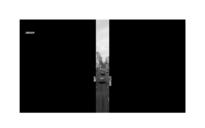
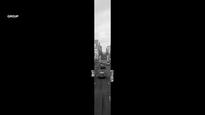
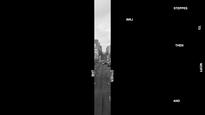
Seventeen words—discrete, variously oriented (horizontally, vertically, in mirror image, etc.)—appear momentarily, in random-seeming sequences, on the black screen surrounding a moving image. Recorded by a stationary camera, the footage is narrowly framed to match the proportions of its subject: a long, straight, one-way, two-lane thoroughfare flanked by tall buildings and traveled by cars heading away from the camera. (Viewers familiar with Brussels might recognize the Rue de la Loi / Wetstraat on its course through the European Quarter, thick with government agencies, toward the center of the Belgian capital.) The proportions of the moving image also recall the found vertical elements—poles supporting street lights and signs, parking meters, traffic barriers, etc.—that Downsbrough often included in his photographs and films, using those uprights as compositional structuring devices. Here, however, the vertical element is the image itself. Centered on the screen, it is flanked by identical wide, black rectangles that serve as fields for fast-disappearing inserted words. The words conjure yet another proportion-related association: that of a book with its covers splayed flat and its spine illuminated with a moving image.
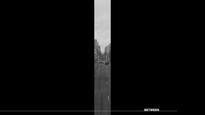
The first words to appear onscreen, and the longest to remain there, are those of the title. THE, in reverse-image, rests on the left edge of the moving image, facing OTHER, on the opposite edge. “The other what?”, one wonders. Then, as cars continue flowing in straight lines in the moving image in the center of the screen, words and a word fragment begin to populate the left side of the screen in no apparent order and in multiple directions: GROUP, ED, AS, CAST, TIME, IN. Just as a viewer might be forming an idea about the relationship of those words to the fixed but motion-filled scene of cars advancing down an urban corridor, the word STEPPES appears on the right-hand screen, and all words disappear from the left. STEPPES, a zinger of a signifier in this context, is soon joined higgledy-piggledy on the right by the less evocative terms TO, THEN, FROM, AND, LINK, SET, and RE. Soon, and only for a heartbeat, the entire screen goes black except for the title words, THE and OTHER. They remain in place on either side of the now-absent moving image, reminding us of their importance while providing no further explanation. The moving image returns as abruptly as it vanished, flanked only by the title words. Then, a white hairline rule advances across the bottom of the screen from left to right. As it crosses the moving image, the title words vanish; and when it reaches the middle of the right-hand screen, the word BETWEEN comes into view and rests on it briefly before disappearing. The line continues its way to the edge of the screen, bringing the work to a close.
The wide open space of the steppes has rarely if ever been invoked more invitingly than in THE OTHER, where it is juxtaposed with the sliver-thin view of a one-way road channeling traffic to a walled-off horizon (notice the obstructed vanishing point). Peripheral vision is entirely cut off. At what cost, Downsbrough doesn’t say, but he implies that it pays to look at the spaces and connections between things, to explore other avenues and ways of perceiving and being in the world.
written by Sarah McFadden
- Formaat DIGITAL FILE(DIGITAL FILE)
- Kleur b&w
- Jaar 2024
- Duur 00:01:45
-
Kunstenaars
-
EVENEMENTEN