MATTHEW BARNEY - DRAWING RESTRAINT 9
ÉCRAN D'ART - SCREENING
Best known for his dazzling, five-film Cremaster cycle, Matthew Barney has created a universe of hybrid creatures and singular crossmedia fusions of sculpture, film, performance, and installation that have established him as one of the most important American artists of his generation. Both before and after completing his epic Cremaster project (1994–2002), the artist has pursued the Drawing Restraint series, a body of work — currently featuring twelve installments, developed from 1987 to the present - that represents many fundamental principles at the core of his art.
Barney’s entire artistic practice investigates the development of form, and Drawing Restraint is based on the notion that form emerges only through struggle against resistance. The idea grew out of the artist’s early experience as an athlete and his thinking about resistance as a catalyst for muscle growth. By extension, he wondered how this bulking of tissue, known as hypertrophy, might make a case for self-imposed resistance as an impetus for creativity. The work proposes the body as an analogy for creative process and a model for the artist’s conception of a productive state based on unresolved tensions between desire, stored potential, and repression.
Invited by the 21st Century Museum of Contemporary Art in Kanazawa to create new work for an exhibition, Barney began Drawing Restraint 9 in 2003 as an opportunity to revisit the Drawing Restraint series through a research-based exploration into Japanese culture. The artist became interested in Japan’s historical position as a host country to foreign guests, how the local rituals are a type of productive restraint, and the interconnectedness of humans and nature as represented in Japanese spiritual philosophy. Customs referenced in the film embody the series’ themes of cyclical biological processes: the metamorphosis of form; the phases of consumption, production, and excretion; and the restriction and release of energy. Also informing the project were the artist’s interest in the historical significance of petroleum jelly and plastics—signature materials in his work—and the broader notion of exploiting fossil fuel, namely the process by which dead organic matter is converted into a source of life-sustaining energy. In the opening sequence of the film, a pair of anonymous hands carefully gift-wraps two halves of a fossilized shell in the elaborate Japanese custom. The scene serves as an introduction to both Japanese ritual and a cycle of transformation, which subtly merge as the narrative unfolds.
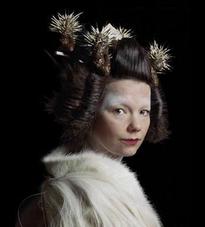
The story in the film takes place in Nagasaki Bay aboard the enormous ship Nisshin Maru—the only factory whaling ship still allowed to operate—and weaves together themes of Japan’s whaling history. The ship functions as a character itself, acting variously as a metaphor for a body in water, a whale in the ocean, or the island of Japan, surrounded by the sea. It is also host to dueling concepts—order and disorder, desire and discipline—that thread the Drawing Restraint series. These forces are manifested through two main narrative structures that unwind simultaneously over the course of the film: the transformation of a large sculpture of petroleum jelly, which goes through numerous stages of entropy before collapsing, and an encounter between two Occidental Guests (Barney and Björk), who are brought to the boat separately and together experience a dramatic metamorphosis.
On the deck of the ship, a gigantic mold in the shape of the artist’s signature field emblem is filled with 25 tons of hot petroleum jelly. As the molten liquid cools, swaying gently with the motion of the ship, each guest undergoes a highly ritualized transformation below deck. Ceremonially shaved and bathed, the guests are suited in elaborate costumes of skin and fur resembling traditional Shinto wedding garments. They are brought together in a formal tea ceremony during which the tea master tells the story of the vessel. On the deck, the crew’s solemn, careful choreography in handling the sculpture mirrors the highly precise, ritualized manner of the tea ceremony below. As a storm begins to rock the ship more violently, the couple comes together in a state of erotic union while molten petroleum jelly overflows from tanks above and begins to fill the room. Halfway submerged, the pair take up flensing knives—used for the ritual dissection of whale carcasses—and cut away the flesh from each other’s lower limbs, revealing their bodies’ mutation into whale-like creatures. With the gradual superimposition of these two interlocking narratives, metaphoric relationships emerge among architectural process, Shinto religious rites, Japan’s whaling history, the implications of fossil fuel consumption, a love story, and the cycle of mammalian evolution.
Drawing Restraint 9 (2005, 135’, color, Japanese Spoken, English Subt)
 The Ecran d’Art series is a monthly screening of artists’ film and/or video jointly organised by argos and Cinema Arenberg, in collaboration with La Cambre Academy
-
do 16.2.2006
21:30 - 21:30 -
Praktische info
Location:
Cinéma Arenberg
Koninginnegalerij 26
1000 Brussel
Entrance fee:
7 / 5,20 Euro - Kunstenaars