TRADITIONS AND CONTRADICTIONS
SCREENING - BLACK BOX
At the outset of the 21st century Asia is facing a period of economic, cultural and political changes, an evolution which is perceived in every stratus of society. Whereas modern Western ideas of democracy, sovereignty and human rights still constitute an anathema in the traditional Asian political establishment, technological innovation and urbanisation impose new models on the social structures, along with an erosion of the collective memory and an anxious sense of place and existence. This ambivalent relationship with the old as well as the new, and an ambiguous feeling of identity make out the main concerns of the artists with regards to the programme of Traditions & Contradictions . Their work investigates into the friction between the expanding globalisation of Western values and capitalism, and traditional forces. The dogma of a single pattern of thinking does not hold out in this respect. Instead a multilayered quest for self-identity manifests itself, an attempt to reconcile cultural heritage with a society in flux.
Introduction by Clare Manchester, independent curator, critic and editor based in Lausanne and London. (Language: English)
All titles are in original language and subtitled in English.
Ou Ning and Cao Fei , The San Yuan Li Project (China)
2003, col., 10’
The village San Yuan Li in Guangzhou province, originally a small rural settlement, has been swallowed at an incredible speed in a vast urban sprawl. Armed with a DV camera and DAT recorder, the artists walk the streets and alleyways of this village-turned-city, showing the confrontation and reconciliation between the process of modernisation and traditional ways of life. They capture a rural community in flux and the bizarre architecture and lifestyle that goes with this.
Chen Shaoxiong, Windows2002 (China)
2002, col., 3’
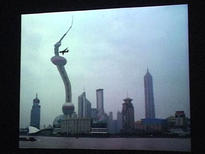
Shaoxiong is a member part of the Big-Tail Elephant Group, an artistic collective originating in Guangzhou, one of the most vibrant centres of cultural activity in China. Shaoxiong investigates the erroneous sense of reality images can communicate. His work is a reflection on terrorism after the September 11 attacks on the World Trade Towers in New York. In Chen’s digital version, planes fly towards a tower but never collide – the plane or the tower turn or twist to avoid impact; perhaps a hint to future architects. In the Venice Biennale catalogue Hou Hanru stated: ’It is to propose various means of manoeuvering against reality, as the artist has stated. That said, it would be more appropriate to consider the piece as an irony directed against the media sensationalism that is a predominant constituent of our synthetic reality.’ The title of the piece is a deliberate reference to the ubiquitous Microsoft software.
Wang Guo Feng, Chinese Utopia (China)
2002, col., 16’
Wang explores the everyday lives of people living in the countryside, far from urban centres, as well as taking us on a visually absorbing tour of China in all its guises, from building sites and frenetic streets to neighbours exchanging gossip and news. The viewer is left with the impression of a country bustling with activity, in a state of flux.
Jiang Zhi, Please give me 50 cents I know where Bin Laden is (China)
2002, col., 4’
Another ironic look at international terrorism in the context of Asia rather than the West.
Lin Yilin, Safely Manoeuvred Through (China)
1995, col., 17’
Lin Yilin is also a member of the Big-Tail Elephant Group. A builder of brick walls, Lin’s artistic vocabulary is based on these walls that for him ’question and negotiate the relationship between people and their built environment S to critically re-appraise the rapidly changing environment and, eventually, to question society’s commonly held ideas and values’. Stable walls are turned into moving ones as Lin transports them brick by brick from one location to another, often disrupting a flows of traffic - both human and vehicular – in the process. The artist often includes other everyday items, including water, bank notes, televisions and even himself in his work, which examines the relationship between sculpture and architecture, and between his actions and the resulting object and the audience.
Zhang Peili, Actors’ Lines (China)
2003, col., 7’
Peili’s work explores personal experience such as feelings of irrationality that give way to depression. He also examines the relationship between the media and society. In Actors’ Lines Peili takes a segment from a Communist-era film, a moment during which a hero is obviously feeling disheartened and is being consoled by a party official. Editing the segment to make the actors’ repeat their lines in a meaningless loop, the artist expunges the original meaning and propaganda from the scene, so questioning the Utopian idealism of the official party line during the communist era, and by extension all values communicated to us through the media.
Yang Zhenzhong , 922 Grains of Rice (China)
2000, col., 8’
Rural in character, this work is a far cry from relentless skyscrapers and expanding cityscapes. A hen and a cockerel occupy the screen, along with three sets of numbers which increase at different rates. The voices of a man and a woman can be heard murmuring the numbers on screen. In fact they are counting the grains of rice consumed by each bird, also shown by the counters on the screen - one for the cockerel and one for the hen, the counter in the middle recording the overall total of grains consumed.
Shimabuku, Then I decided to give a tour of Tokyo to the Octopus from Akashi (Japan)
2000, col., 7’
In this lyrical work the artist travels from the Akashi Sea, on one side of the Japan, to Tokyo on the other, with a live octopus, taking a tour of Tokyo Tower and Tsukiji, the city’s famous fish market, along the way. The artist’s dream is that the octopus will tell other octopi about the journey once released back into the sea. The absurdity of the project endows it with symbolic meaning, the desire to give an octopus an inaccessible experience perhaps the manifestation of the artist’s desire for experience beyond everyday cultural norms.
Watanabe Go, Tidy Up (Japan)
1999, col., 10’
This endless loop of the rearrangement of a tiny space for different living purposes reinforces the idea of a monotonous, predictable existence. Tidy Up could also be read as an inability to escape from a predetermined life-pattern, as if the protagonist is trapped by unchanging cultural tradition.
Arahmaiani Are you happy Mr Jan? (Indonesia)
2003, col., 4’
Arahmaiani, The Past has not passed (Indonesia)
2002, col., 4’
Arahmaiani’s work is a reflection of Indonesia’s colonial past, and the cultural and political implications of this history, and the clash between tradition and modernisation.
Kim Sooja, A Beggar Woman – Lagos (South Korea)
2001, col., 8’
This silent works shows the artist seated, immobile, in the midst of a busy thoroughfare in Lagos. Curious onlookers sometimes stop to watch before moving on. Kimsooja’s work is an expression of the will to communicate across cultural, territorial borders and across continents, and an affirmation of multi-cultural plurality and diverse histories and cultures.
Introduction by Clare Manchester, independent curator, critic and editor based in Lausanne and London. (Language: English)
All titles are in original language and subtitled in English.
Ou Ning and Cao Fei , The San Yuan Li Project (China)
2003, col., 10’
The village San Yuan Li in Guangzhou province, originally a small rural settlement, has been swallowed at an incredible speed in a vast urban sprawl. Armed with a DV camera and DAT recorder, the artists walk the streets and alleyways of this village-turned-city, showing the confrontation and reconciliation between the process of modernisation and traditional ways of life. They capture a rural community in flux and the bizarre architecture and lifestyle that goes with this.
Chen Shaoxiong, Windows2002 (China)
2002, col., 3’
Shaoxiong is a member part of the Big-Tail Elephant Group, an artistic collective originating in Guangzhou, one of the most vibrant centres of cultural activity in China. Shaoxiong investigates the erroneous sense of reality images can communicate. His work is a reflection on terrorism after the September 11 attacks on the World Trade Towers in New York. In Chen’s digital version, planes fly towards a tower but never collide – the plane or the tower turn or twist to avoid impact; perhaps a hint to future architects. In the Venice Biennale catalogue Hou Hanru stated: ’It is to propose various means of manoeuvering against reality, as the artist has stated. That said, it would be more appropriate to consider the piece as an irony directed against the media sensationalism that is a predominant constituent of our synthetic reality.’ The title of the piece is a deliberate reference to the ubiquitous Microsoft software.
Wang Guo Feng, Chinese Utopia (China)
2002, col., 16’
Wang explores the everyday lives of people living in the countryside, far from urban centres, as well as taking us on a visually absorbing tour of China in all its guises, from building sites and frenetic streets to neighbours exchanging gossip and news. The viewer is left with the impression of a country bustling with activity, in a state of flux.
Jiang Zhi, Please give me 50 cents I know where Bin Laden is (China)
2002, col., 4’
Another ironic look at international terrorism in the context of Asia rather than the West.
Lin Yilin, Safely Manoeuvred Through (China)
1995, col., 17’
Lin Yilin is also a member of the Big-Tail Elephant Group. A builder of brick walls, Lin’s artistic vocabulary is based on these walls that for him ’question and negotiate the relationship between people and their built environment S to critically re-appraise the rapidly changing environment and, eventually, to question society’s commonly held ideas and values’. Stable walls are turned into moving ones as Lin transports them brick by brick from one location to another, often disrupting a flows of traffic - both human and vehicular – in the process. The artist often includes other everyday items, including water, bank notes, televisions and even himself in his work, which examines the relationship between sculpture and architecture, and between his actions and the resulting object and the audience.
Zhang Peili, Actors’ Lines (China)
2003, col., 7’
Peili’s work explores personal experience such as feelings of irrationality that give way to depression. He also examines the relationship between the media and society. In Actors’ Lines Peili takes a segment from a Communist-era film, a moment during which a hero is obviously feeling disheartened and is being consoled by a party official. Editing the segment to make the actors’ repeat their lines in a meaningless loop, the artist expunges the original meaning and propaganda from the scene, so questioning the Utopian idealism of the official party line during the communist era, and by extension all values communicated to us through the media.
Yang Zhenzhong , 922 Grains of Rice (China)
2000, col., 8’
Rural in character, this work is a far cry from relentless skyscrapers and expanding cityscapes. A hen and a cockerel occupy the screen, along with three sets of numbers which increase at different rates. The voices of a man and a woman can be heard murmuring the numbers on screen. In fact they are counting the grains of rice consumed by each bird, also shown by the counters on the screen - one for the cockerel and one for the hen, the counter in the middle recording the overall total of grains consumed.
Shimabuku, Then I decided to give a tour of Tokyo to the Octopus from Akashi (Japan)
2000, col., 7’
In this lyrical work the artist travels from the Akashi Sea, on one side of the Japan, to Tokyo on the other, with a live octopus, taking a tour of Tokyo Tower and Tsukiji, the city’s famous fish market, along the way. The artist’s dream is that the octopus will tell other octopi about the journey once released back into the sea. The absurdity of the project endows it with symbolic meaning, the desire to give an octopus an inaccessible experience perhaps the manifestation of the artist’s desire for experience beyond everyday cultural norms.
Watanabe Go, Tidy Up (Japan)
1999, col., 10’
This endless loop of the rearrangement of a tiny space for different living purposes reinforces the idea of a monotonous, predictable existence. Tidy Up could also be read as an inability to escape from a predetermined life-pattern, as if the protagonist is trapped by unchanging cultural tradition.
Arahmaiani Are you happy Mr Jan? (Indonesia)
2003, col., 4’
Arahmaiani, The Past has not passed (Indonesia)
2002, col., 4’
Arahmaiani’s work is a reflection of Indonesia’s colonial past, and the cultural and political implications of this history, and the clash between tradition and modernisation.
Kim Sooja, A Beggar Woman – Lagos (South Korea)
2001, col., 8’
This silent works shows the artist seated, immobile, in the midst of a busy thoroughfare in Lagos. Curious onlookers sometimes stop to watch before moving on. Kimsooja’s work is an expression of the will to communicate across cultural, territorial borders and across continents, and an affirmation of multi-cultural plurality and diverse histories and cultures.
-
Thu 05.2.2004
20:30 - 20:30 -
Practical info
Location:
argos
Entrance fee:
3 euro - Artists